MRCS Exam for International Doctors
✍️ Written by: Dr Hanif Khaan — Medical professional and founder of WispGold. With firsthand experience of the IMG journey to UK medical practice.
The MRCS exam for international doctors is one of the most recognised and career-defining qualifications you can hold as a surgeon working in the UK. If you educated in Saudi Arabia, Sri Lanka, India, Pakistan, Egypt or anyplace else in the world, passing the MRCS (Membership of the Royal Colleges of Surgeons) opens the door to NHS surgical postings, specialist training and a long term surgical career in the UK.
However, the MRCS is not an easy exam. It is a two-part test: a rigorous written paper and a demanding clinical OSCE. To pass on the first time, structured concentrated preparation is required. In this guide, we’ll fill you in on all you need to know what’s on the exam, who can take it, how much it costs, the 2026 dates, how difficult it is to pass and how best to prepare.
If you are looking for it, this is the whole MRCS exam guide for overseas doctors.
What Is the MRCS Exam?
The MRCS Membership of the Royal Colleges of Surgeons is a postgraduate surgical qualification administered jointly by four UK Royal Colleges of Surgery:
- Royal College of Surgeons of England (RCSEng)
- Royal College of Surgeons of Edinburgh (RCSEd)
- Royal College of Physicians and Surgeons of Glasgow (RCPSG)
- Royal College of Surgeons in Ireland (RCSI)
The MRCS is the internationally-recognised first-stage surgical membership certification in the UK and Ireland. This is a normal requirement for doctors starting surgical specialty training in the NHS and a precondition for proceeding towards Fellowship of the Royal Colleges of Surgeons (FRCS) and ultimately a consultant surgeon job.
Important for IMGs: the MRCS exam is available for international doctors from any country in the world. You do not need to be working in the UK or to be GMC registered to take Part A. This is one of the most accessible high-value certifications for globally trained surgeons wishing to create a UK career from overseas.
MRCS vs PLAB – What Is the Difference?
PLAB (and the new UKMLA) is a general licensing exam that proves you can practise medicine safely in the UK at a foundation level. MRCS is a specialty-specific postgraduate qualification that proves you have the surgical knowledge and clinical skills to enter surgical training. If your career goal is surgery, MRCS is the stronger, more targeted route and passing it may also qualify you for GMC registration without needing PLAB.
MRCS Exam Eligibility for International Doctors
To sit the MRCS Part A, you must hold a primary medical qualification (MBBS, MD, or equivalent) that is:
- Acceptable to the UK General Medical Council (GMC) for full or provisional registration, OR
- Acceptable to the Medical Council of Ireland for full or temporary registration
You do not need to have completed a specific period of postgraduate surgical training before sitting Part A this makes the exam accessible to doctors relatively early in their surgical careers. You also do not need UK GMC registration to sit Part A, meaning international doctors can sit the exam at approved test centres in their home countries.
For Part B: You must have passed MRCS Part A before you can apply. There is no mandatory training duration requirement between Part A and Part B, though the Royal Colleges strongly recommend accumulating surgical experience before attempting the OSCE.
MRCS Part A Exam — Format, Syllabus and What to Expect
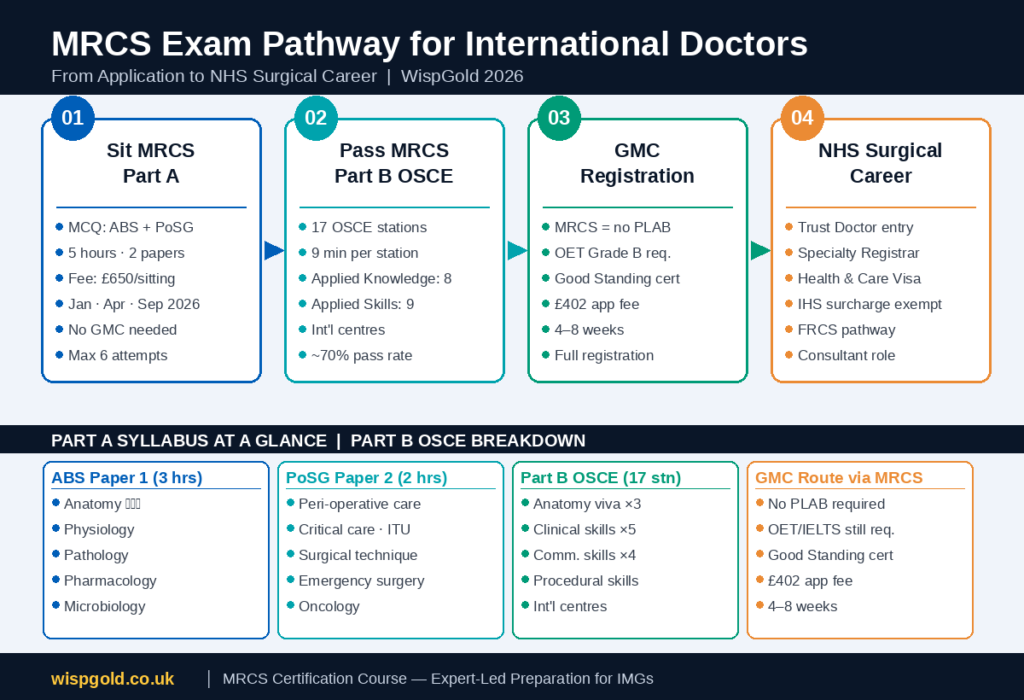
MRCS Part A is a written examination consisting of two papers, both taken on the same day:
| Paper | Full Name | Duration | Format |
| Paper 1 | Applied Basic Sciences (ABS) | 3 hours | Single Best Answer (SBA) MCQs |
| Paper 2 | Principles of Surgery in General (PoSG) | 2 hours | Single Best Answer (SBA) MCQs |
Total exam time: 5 hours. Both papers are computer-based and delivered through Pearson VUE test centres, which are located across the UK and in many international cities.
MRCS Part A Syllabus — What Is Tested?
Paper 1 — Applied Basic Sciences (ABS) tests your knowledge of:
- Anatomy — the largest and most heavily tested topic in the MRCS
- Physiology — normal body function and clinical applications
- Pathology — disease processes, histopathology, and inflammation
- Pharmacology — drug mechanisms, anaesthesia, and surgical pharmacology
- Microbiology — infection, antibiotics, and wound healing
Paper 2 — Principles of Surgery in General (PoSG) tests your knowledge of:
- Peri-operative care — pre-op assessment, fluid management, anaesthesia
- Post-operative management — complications, wound care, pain management
- Surgical technique — instruments, sutures, diathermy, haemostasis
- Critical care — ITU management, sepsis, shock
- Emergency surgery — trauma, acute abdomen, vascular emergencies
- Surgical oncology — cancer staging, treatment principles
MRCS Part A Exam Dates and Fees 2026
MRCS Part A is held three times per year:
| 2026 Sitting | Approximate Exam Window | Registration Deadline |
| January 2026 | January | Approximately 8 weeks before |
| April 2026 | April | Approximately 8 weeks before |
| September 2026 | September | Approximately 8 weeks before |
Exam fee: £650 per sitting (UK and international centres). The fee is non-refundable if you withdraw after the deadline.
You are permitted a maximum of 6 attempts at MRCS Part A, with one additional attempt available if you can demonstrate verified additional educational experience approved by your educational supervisor.
MRCS Part B OSCE — Format, Stations and Pass Mark
MRCS Part B is an Objective Structured Clinical Examination (OSCE). Unlike Part A, which tests knowledge, Part B tests whether you can apply that knowledge in real clinical scenarios, under examination conditions, in front of trained examiners.
MRCS Part B OSCE Station Format
The exam consists of 17 examined stations (plus 1 potential pilot station that does not count toward your mark). Each station:
- Lasts 9 minutes (plus 1 minute to read the station instructions)
- Is worth a maximum of 20 marks
- Is assessed by trained examiners using structured mark sheets
The 17 stations are divided into two Broad Content Areas (BCAs):
| Broad Content Area | Stations | Topics Covered |
| Applied Knowledge | 8 stations | Anatomy (×3), Surgical Pathology (×2), Applied Surgical Science & Critical Care (×3) |
| Applied Skills | 9 stations | Clinical & Procedural Skills (×5), Communication Skills (×4) |
MRCS Part B Pass Mark — How Is It Calculated?
The pass mark for MRCS Part B is not a fixed percentage it is set individually for each exam sitting based on the difficulty of the stations and the standard expected of a safe surgical trainee. In practice, you need to pass both Broad Content Areas in the same sitting:
- Approximately 70% of stations must be passed within each BCA
- A strong performance in one station can compensate for a weaker performance in another within the same BCA
- Marks cannot be carried over between Applied Knowledge and Applied Skills you must pass both
Overall pass rate: approximately 65–70% of candidates pass MRCS Part B at each sitting. Adequate clinical experience combined with structured OSCE preparation significantly improves your chances.
MRCS Part B International Exam Centres 2026
Part B OSCE sittings are offered at multiple international locations, including:
- Egypt — Cairo and Alexandria
- Pakistan — Karachi
- India — Mumbai and Trivandrum
- Malaysia — Kuala Lumpur
- UAE — Abu Dhabi
- UK — Multiple centres across England and Scotland
Check the Royal College of Surgeons of Edinburgh or RCSEng website for specific 2026 international sitting dates and registration windows.
How to Pass the MRCS Exam — Preparation Strategy for IMGs
The most common reason international doctors fail MRCS, particularly Part A is underestimating anatomy. The Applied Basic Sciences paper is heavily anatomy-weighted, and many IMGs have not revisited systematic anatomy since undergraduate studies. Here is the preparation strategy that works:
MRCS Part A Preparation Plan
Start 4–6 months before your exam date. Aim for at least 2–3 hours of focused study per day alongside clinical work.
- Anatomy (40% of study time): Use Gray’s Anatomy for Students, Snell’s Clinical Anatomy, and surgical anatomy resources. Practise on past MCQs specifically.
- Physiology (20%): Focus on applied physiology relevant to surgery — fluid balance, acid-base, respiratory physiology, cardiovascular physiology.
- Pathology (15%): Robbins Basic Pathology is the standard reference. Focus on surgical pathology themes.
- Peri-operative care and critical care (25%): These PoSG topics are directly clinical and benefit from relating content to your own patient cases.
MCQ banks: Use dedicated MRCS MCQ banks such as Pastest, MedIQ, or MRCS-specific question banks. Aim to complete at least 1,500–2,000 MCQs under timed conditions before your exam.
MRCS Part B OSCE Preparation Plan
Start 3–4 months before your OSCE date. OSCE preparation is fundamentally different from written exam preparation — you cannot revise your way through it alone.
- Find a study partner: OSCE stations must be practised aloud, in pairs, with one person playing the examiner. Practise every station type at least 3 times.
- Communication stations: These are the most underestimated stations. Practise delivering bad news, obtaining informed consent, and explaining procedures clearly and with empathy.
- Clinical skills: Practise examination routines (cardiovascular, abdominal, peripheral vascular, hernia) to the point where they are completely automatic.
- Anatomy viva: Practise describing anatomical structures verbally to an examiner. This is very different from writing about anatomy in MCQs.
- Mock OSCEs: At least 2 full mock OSCE circuits before your exam date, ideally with feedback from someone who has passed the MRCS Part B.
MRCS Exam and GMC Registration — What You Need to Know
One of the most valuable aspects of the MRCS for international doctors is its relationship with GMC registration. Doctors who hold a postgraduate qualification recognised by the GMC including the full MRCS (both Part A and Part B) may be eligible to apply for GMC full registration without sitting the PLAB exam or the new UKMLA.
This means that for surgical IMGs, passing the MRCS represents a double benefit:
- A highly recognised surgical qualification that unlocks NHS surgical training posts
- A potential route to GMC registration without the additional time and cost of PLAB/UKMLA
For full details of the GMC registration pathway for MRCS holders, see our guide: GMC Registration for International Doctors Complete 2026 Guide.
How WispGold Prepares You for the MRCS Exam
WispGold’s MRCS Certification Course is built for international doctors specifically for IMGs who are preparing outside the UK and may not have access to the same structured surgical training environment as UK-based trainees.
Our course covers:
- Full MRCS Part A syllabus — ABS and PoSG — with topic-by-topic expert teaching
- High-yield anatomy, physiology, pathology, and surgical science sessions
- Timed MCQ practice with detailed explanations and performance tracking
- MRCS Part B OSCE coaching — station-by-station practice for all 17 station types
- Live communication skills sessions with feedback from experienced surgical educators
- Full mock exams for both Part A and Part B under real exam conditions
All sessions are fully online, accessible from anywhere in the world, and available as both live coached sessions and self-paced recorded content.
Enrol in WispGold’s MRCS Certification Course | Book a Free Consultation | Use code WG10 for 10% off.
Frequently Asked Questions About the MRCS Exam for International Doctors
Can international doctors sit the MRCS exam without GMC registration?
Yes. You do not need GMC registration to sit MRCS Part A. Pearson VUE test centres are available internationally, and international doctors can sit the exam in their home country. GMC registration is required before you can work in the NHS, but not to take the MRCS exam itself.
How many times can I attempt the MRCS?
You are permitted a maximum of 6 attempts at MRCS Part A, with one possible additional attempt subject to approval. There is no specified limit on Part B attempts, though the Colleges expect candidates to demonstrate progression. Check with the administering Royal College for current attempt policies.
How long does it take to prepare for MRCS Part A?
Most candidates require 4 to 6 months of structured preparation. The exact time depends on how recently you studied anatomy and basic sciences, and how much time you can dedicate to daily study. Anatomy is consistently the highest-weighted topic and typically requires the most preparation time.
Does passing MRCS mean I can skip PLAB?
Holding the full MRCS (Part A and Part B) may make you eligible for GMC full registration without PLAB or the UKMLA. This is assessed on a case-by-case basis by the GMC. You would need to apply through the GMC’s international medical graduate registration route with MRCS as your postgraduate qualification.
What is the MRCS exam fee for international doctors in 2026?
MRCS Part A costs £650 per sitting. MRCS Part B OSCE fees vary by sitting and location — check the RCSEng or RCSEd website for the current fee schedule for international centres.
Is the MRCS recognised outside the UK?
Yes. The MRCS is internationally recognised as a postgraduate surgical qualification and is respected across the Middle East, South Asia, Australia, and Africa. Many countries’ surgical training programmes recognise MRCS as evidence of surgical competence.
What is the difference between MRCS and FRCS?
MRCS (Membership) is the entry-level surgical postgraduate qualification required to enter specialty surgical training in the UK. FRCS (Fellowship) is the exit-level qualification that certifies completion of a full surgical training programme and is required to be listed on the GMC Specialist Register as a surgeon. MRCS comes first; FRCS comes after completing specialty training.
Which Royal College administers the MRCS?
The MRCS is administered jointly by the Intercollegiate Committee for Basic Surgical Examinations (ICBSE), on behalf of the Royal College of Surgeons of England, the Royal College of Surgeons of Edinburgh, the Royal College of Physicians and Surgeons of Glasgow, and the Royal College of Surgeons in Ireland. The qualification is recognised equally regardless of which College administers your sitting.
Final Word — The MRCS Is Your Gateway to a UK Surgical Career
For international doctors the MRCS exam is not merely a certificate, it is the key which opens the door to NHS surgical training, GMC registration without PLAB and a legitimate long-term surgical career in one of the world’s most respected healthcare systems.
The pathway is clearly laid out – pass Part A, gain surgical experience, pass the Part B OSCE, apply for GMC registration and your first NHS surgical post. This is a journey that thousands of international doctors do every year. The ones who do it well are the ones who start with the appropriate framework and the correct guidance.
WispGold is here to be your guidance. See our MRCS Certification Course or book a free consultation with our staff to organize your preparation.
This guide reflects MRCS examination information published by the Royal Colleges of Surgeons and the GMC as of July 2026. Exam fees, dates, and regulations are subject to change always verify at rcseng.ac.uk or rcsed.ac.uk before applying.

Dr Hanif Khaan is a medical professional and founder of WispGold, a UK-based certification training platform helping international medical graduates navigate GMC registration, Royal College exams, English exams and NHS career pathways. With firsthand experience of the IMG journey to UK medical practice, Dr Khaan built WispGold to give international doctors the structured, expert-led preparation that makes the difference between passing and resitting. All content on WispGold is written and reviewed to reflect all College standards.