NHS Jobs for International Doctors: A Comprehensive Step-by-Step Guide
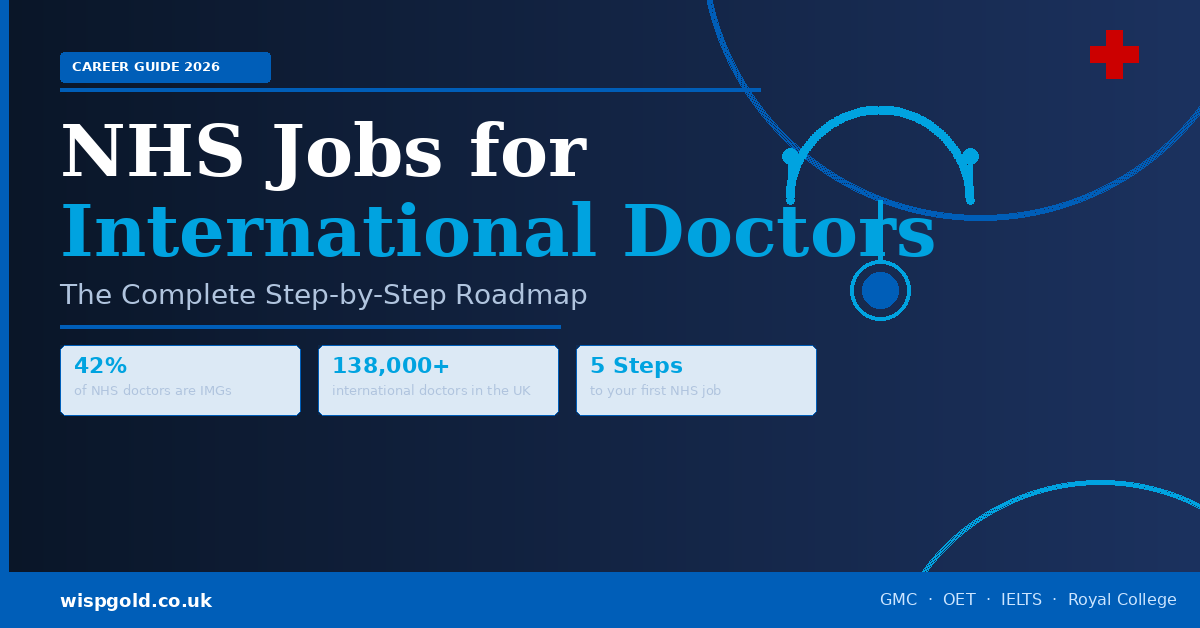
If you are looking for NHS jobs for international doctors, you are not alone. Over 138,000 doctors practicing in the UK trained outside of Britain. That’s 42% of the total licensed medical workforce. Every year the NHS aggressively recruits globally trained doctors, and the way into it is structured yet definitely possible.
This guide gives you the complete, honest, step-by-step roadmap for landing NHS jobs as an international doctor in 2026 — from your English language test all the way to your first NHS payslip. Whether you trained in Nigeria, India, Pakistan, Egypt, the Philippines, or anywhere else in the world, this is the roadmap you need.
What Is an International Medical Graduate (IMG) Applying for NHS Jobs?
Any doctor who has qualified in medicine (MBBS, MD or equivalent) outside the United Kingdom is called an International Medical Graduate or IMG. If this sounds like you, and you wish to practice medicine in the UK, then every step in this tutorial applies to you.
IMGs are employed by the NHS at all levels of seniority – from trust doctor and SHO jobs (similar to junior doctor posts) through to specialty registrar, consultant and GP appointments. However, before any NHS Trust can legally hire you, you need to have registration with a licence to practise from the General Medical Council (GMC). That’s the non-negotiable starting point for every international doctor looking for NHS jobs for international doctors in the UK.
Here are the five stages of the IMG pathway to NHS employment:
- Pass your English language test — OET or IELTS
- Pass the licensing assessment — UKMLA (replacing PLAB)
- Achieve GMC registration
- Apply for your UK work visa
- Search, apply, and secure your NHS job
Let’s break each one down.
OET for Doctors — The English Test Most IMGs Choose for NHS
Every international doctor applying for GMC registration must demonstrate English language proficiency. The two accepted tests are the OET (Occupational English Test) and the IELTS Academic. Both are valid, but they serve different needs and understanding which suits you is the first smart decision you make on this journey.
OET for doctors is widely considered the preferred route for clinically practising IMGs. Unlike general English tests, the OET uses real healthcare scenarios patient referral letters, medical consultations, discharge summaries which means you are being tested in the exact language you will use on an NHS ward. Doctors consistently report that OET feels more relevant and more achievable because it mirrors clinical communication rather than abstract academic writing.
OET Score Requirements for NHS Jobs
To satisfy the GMC’s English language requirement using OET, you must achieve a minimum Grade B in all four sub-tests: Listening, Reading, Writing, and Speaking. Your OET results must be no more than two years old at the point of your GMC application.
👉 Prepare with WispGold’s expert-led OET Certification Course — live coaching, medical scenario practice, and full mock tests.
IELTS Requirements for GMC Registration
If you prefer the IELTS Academic route, the GMC requires the following minimum scores:
IELTS Score for GMC Registration
| Sub-test | Minimum Score Required |
|---|---|
| Listening | 7.5 |
| Reading | 7.5 |
| Writing | 7.5 |
| Speaking | 8.0 |
Note that IELTS scores must also be no older than two years at the time of your GMC application.
IELTS is a strong choice if you are applying to UK universities for postgraduate academic study alongside your clinical career, or if OET centres are less accessible in your region. For a direct comparison of both tests for doctors, see our full guide: OET vs IELTS for Doctors — Which Should You Choose?
👉 Prepare with WispGold’s structured IELTS Certification Course — targeted coaching built around the exact GMC band score requirements.
GMC Registration for International Doctors — Step by Step
GMC registration is the legal licence that authorises you to practise medicine anywhere in the UK. Without it, no NHS Trust nor any private hospital can legally employ you as a doctor. Securing GMC registration is therefore the single most important milestone in your journey toward NHS jobs for international doctors.
GMC Registration Requirements for Overseas Doctors
To complete your GMC full registration application, you will need to provide:
- Your primary medical qualification (PMQ) — verified through the Intealth/MyIntealth platform (which replaced EPIC in 2024)
- A Certificate of Good Standing (or equivalent professional standing certificate) from your home country’s medical regulator
- Proof of English language proficiency — your OET or IELTS results
- Evidence of your licensing assessment — UKMLA, PLAB, or an approved equivalent
- A minimum of 12 months of continuous postgraduate clinical experience (internship) including at least 3 months in medicine and 3 months in surgery
- Identity documents, a recent passport-style photograph
- The completed application form and current GMC fee (£433 for registration with a licence to practise)
Alternative qualification routes: Some IMGs can apply for GMC full registration without sitting PLAB or the UKMLA. This is possible if you hold or are working towards a UK Royal College qualification such as MRCS, MRCP, MRCOG, MRCPsych, or MRCGP. Royal College membership is one of the fastest routes to bypassing the UKMLA and accessing higher-grade NHS posts simultaneously.
👉 Explore WispGold’s Royal College Exam Preparation Courses — MRCS, RCEM, RCOG, RCGP, and RCPsych, all fully online.
How Long Does GMC Registration Take?
It usually takes the GMC 4 to 8 weeks to process a complete and valid application. This process is greatly extended when applications are incomplete, missing documentation, test results expired or qualifications unconfirmed. The most usual delay is the wait for the Certificate of Good Standing from your home country medical authority, which might take several weeks to get. Begin collecting your papers well before your tests are over.
UK Health and Care Visa for International Doctors
With GMC registration and an offer of employment from the NHS, you are now ready to apply for your UK work visa. For most international doctors, the correct option is the Health and Care Worker Visa – a dedicated subclass of the UK Skilled Worker visa which has important benefits for NHS personnel.
Health and Care Worker Visa Requirements 2026
To qualify, you must:
- Hold a confirmed job offer from a UK employer with a Home Office Sponsor Licence (every NHS Trust qualifies)
- Be working in an eligible healthcare occupation — doctors are fully included
- Meet the salary threshold based on NHS national pay scales:
- Foundation-equivalent / Trust Doctor posts: from £40,190 per year (2026/27)
- Core / Specialty Training (CT/ST1-2): from £49,909 per year
- Specialty Registrar (ST3+): up to £76,582 per year
- Consultant: £105,504 and above
- Demonstrate English language ability at B2 level under the CEFR — your OET or IELTS results satisfy this
Key benefits of the Health and Care Worker Visa over the standard Skilled Worker visa:
- Reduced application fees from £304 (up to 3 years) or £590 (over 3 years)
- Full exemption from the Immigration Health Surcharge (IHS) — saving applicants thousands of pounds
- Fast-tracked processing by UK Visas and Immigration
- Dependants (spouse, partner, and children under 18) can accompany you to the UK
Your NHS Trust employer will issue your Certificate of Sponsorship (CoS) once your job offer is confirmed, and their HR team will typically guide you through the application process.
How to Apply for NHS Jobs as an International Doctor
With your GMC registration either secured or in progress, and your English test results in hand, you can begin your NHS job search. Here is how the process works specifically for international medical graduates.
Where to Find NHS Jobs for International Doctors
- NHS Jobs (jobs.nhs.uk): The official NHS vacancy portal for England. Filter by specialty, grade, location, and visa sponsorship availability. This is your primary resource.
- BMJ Careers (careers.bmj.com): A trusted platform listing doctor-specific roles, including specialty training posts and senior clinical positions.
- Medical recruitment agencies: Specialists such as IMG Connect, BDI Resourcing, and Remedium Partners focus exclusively on placing international doctors in NHS roles and can significantly speed up your job search.
- Royal College job boards: Each Royal College maintains specialty-specific listings, particularly useful once you hold a relevant college qualification.
What NHS Grade Will I Start At as an IMG?
Most IMGs entering the NHS for the first time begin at one of the following grades:
- Trust Doctor / SHO: The most common entry point, equivalent to foundation year 2 (FY2) or core training year 1 (CT1). Open to all IMGs.
- Specialty Registrar (ST3+): For more experienced doctors with relevant Royal College qualifications or substantial postgraduate training.
- SAS (Specialty and Associate Specialist) Doctor: For experienced IMGs not seeking formal training, with greater clinical autonomy.
- Consultant: For the most senior IMGs with full specialist accreditation matching UK standards.
2026 Important Update: The Medical Training Prioritisation Act 2026 (Royal Assent: March 2026) now prioritises UK medical school graduates for formal foundation and specialty training posts. Non-training service posts which make up the majority of NHS clinical vacancies remain fully open to IMGs. Holding a Royal College qualification is now a stronger differentiator than ever for IMGs seeking competitive NHS positions.
NHS Doctor Salary for International Doctors 2026
One of the most frequently searched questions by IMGs is what they can expect to earn. NHS doctor pay is governed by national pay scales agreed between NHS Employers and the British Medical Association (BMA).
NHS Doctor Pay by Grade (2026/27, England)
| Grade | Basic Annual Salary |
|---|---|
| Foundation Year 1 (FY1) | £40,190 |
| Foundation Year 2 (FY2) / Trust Doctor | £45,994 |
| Core Training / ST1-ST2 | £49,909 |
| Specialty Registrar ST3+ | £61,825 – £76,582 |
| Consultant | £105,504 – £139,882 |
| GP (Salaried) | £70,000 – £100,000+ |
On top of basic salary, NHS doctors earn additional pay for on-call rotas, night shifts, weekend working, and additional duty hours. In practice, this can increase your take-home pay by 20–40% above the basic rate making NHS roles financially competitive on a global scale.
How WispGold Helps International Doctors Get NHS Jobs
Every milestone on the IMG pathway to NHS employment involves a certification checkpoint. WispGold was built specifically to support international doctors through each one of those checkpoints — with expert-led online courses that match the exact standards of the GMC, NHS, and UK Royal Colleges.
Our courses are 100% online, accessible from anywhere in the world, and taught by UK-certified educators including former Royal College examiners.
- OET Certification Course — Medical scenario-based coaching, mock tests, and personalised writing feedback to achieve Grade B across all four sub-tests.
- IELTS Certification Course — Structured preparation targeting GMC band score requirements, with live sessions and self-paced modules.
- MRCS Certification Course — Comprehensive Part A and Part B (OSCE) preparation for international surgeons pursuing Royal College membership.
- RCEM Certification Course — MRCEM exam preparation for doctors pursuing NHS emergency medicine.
- RCOG Certification Course — Full MRCOG preparation for obstetricians and gynaecologists.
- RCGP Certification Course — MRCGP exam support for doctors entering UK general practice.
- RCPsych Certification Course — MRCPsych coaching for international psychiatrists joining the UK mental health system.
Use code WG10 for 10% off your first course.
👉 Explore All Courses | 👉 Book a Free Consultation
Frequently Asked Questions About NHS Jobs for International Doctors
Can international doctors work in the NHS in 2026?
Yes. International doctors make up over 42% of the UK’s licensed medical workforce. While the Medical Training Prioritisation Act 2026 prioritises UK graduates for formal training posts, the vast majority of NHS clinical roles — trust doctor, SHO, SAS, and consultant posts — remain fully open to IMGs.
Do I need GMC registration before applying for NHS jobs?
You need GMC registration before you can legally start work, but you can begin applying for NHS jobs while your GMC application is in progress. Many NHS Trusts will make a conditional job offer pending GMC registration confirmation.
Which is better for NHS jobs — OET or IELTS?
Both are accepted by the GMC. Most IMGs pursuing clinical NHS careers prefer OET because it uses healthcare-specific scenarios. IELTS Academic is better if you also need language proof for UK university applications. Read our full comparison: OET vs IELTS for Doctors.
How much does GMC registration cost in 2026?
The GMC registration fee is currently £433 for registration with a licence to practise. The annual retention fee is also £433 (reduced to £166 for doctors earning below £40,000 per year).
How long does the full IMG journey take from start to first NHS job?
Realistically, the end-to-end process takes 9 to 18 months, depending on how prepared you are, how quickly you pass your exams, and how long document verification takes. Starting your exam preparation early and collecting your documents simultaneously is the best way to compress this timeline.
Can my family join me in the UK on a Health and Care Worker Visa?
Yes. Your spouse or partner and any dependent children under 18 can apply to join you in the UK as dependants on the Health and Care Worker visa route.
Do NHS hospitals sponsor international doctors?
Yes. All NHS Foundation Trusts hold Home Office Sponsor Licences, which means they are fully authorised to issue Certificates of Sponsorship (CoS) for international doctors applying under the Health and Care Worker Visa route.
What is the UKMLA and does it replace PLAB?
The UKMLA (UK Medical Licensing Assessment) is the GMC’s new licensing assessment that is replacing the PLAB exam. It consists of two parts: the Applied Knowledge Test (AKT) and a Clinical and Professional Skills Assessment (CPSA). Doctors who pass USMLE, AMC, MCCQE, or hold Royal College qualifications may qualify for GMC registration without sitting the UKMLA.
Final Word: Your NHS Career Starts With the Right Preparation
NHS jobs for international doctors are not just available — they are in demand. The NHS relies on internationally trained doctors to function, and that reliance is not going away. What separates the IMGs who make it quickly from those who take years is preparation: the right exams, passed efficiently, with the right guidance behind them.
Your English language certification and your GMC registration are the gates. Pass through them and the NHS is open to you. WispGold exists to make sure you pass through those gates as quickly and confidently as possible.
Ready to start? Explore our certification courses or book a free consultation with our team today.
This article reflects publicly available guidance from the GMC, NHS England, and UK Visas and Immigration as of July 2026. Always verify current requirements directly at gmc-uk.org before submitting your application.

Dr Hanif Khaan is a medical professional and founder of WispGold, a UK-based certification training platform helping international medical graduates navigate GMC registration, Royal College exams, English exams and NHS career pathways. With firsthand experience of the IMG journey to UK medical practice, Dr Khaan built WispGold to give international doctors the structured, expert-led preparation that makes the difference between passing and resitting. All content on WispGold is written and reviewed to reflect all College standards.